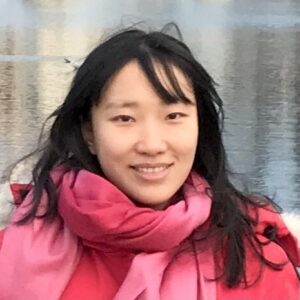
Ke Fang’s research aims at understanding the universe through its energetic messengers, including high-energy neutrinos, gamma rays, and ultrahigh energy cosmic rays. Her work includes analysis efforts on observational data from HAWC, IceCube, and Fermi-LAT, as well as theoretical studies of astroparticle sources using numerical simulations.
Ke Fang is an associate professor at the Department of Physics at UW–Madison. She joined UW–Madison and the Wisconsin IceCube Particle Astrophysics Center (WIPAC) as an assistant professor in 2021. Before that she was an NASA Einstein Fellow at Stanford University (2018-2020) and a Joint Space-science Institute Fellow at University of Maryland and NASA-Goddard (2015-2018). She received her Ph.D. from the University of Chicago in 2015.
Ke can be reached at kefang@physics.wisc.edu and Chamberlin 4118.
News & Highlights
-
WIPAC study provides a clue about a feature in the spectrum of cosmic neutrinos
-
Four professors earn promotions, including tenure for Ke Fang
-
phys.org news: TeV halos could be a common feature of middle-aged pulsars, study shows
-
HAWC detection of high-energy gamma-ray emission surrounding middle-aged pulsars
-
Gamma-Ray Halos May Be Common Around Pulsars
- Sloan Research Fellowship, 2024
- NSF CAREER Award, 2023
- Shakti P. Duggal Award, for Early Career Contributions in Cosmic Ray Physics, 2021
- NASA Einstein Fellowship, 2018-2020